
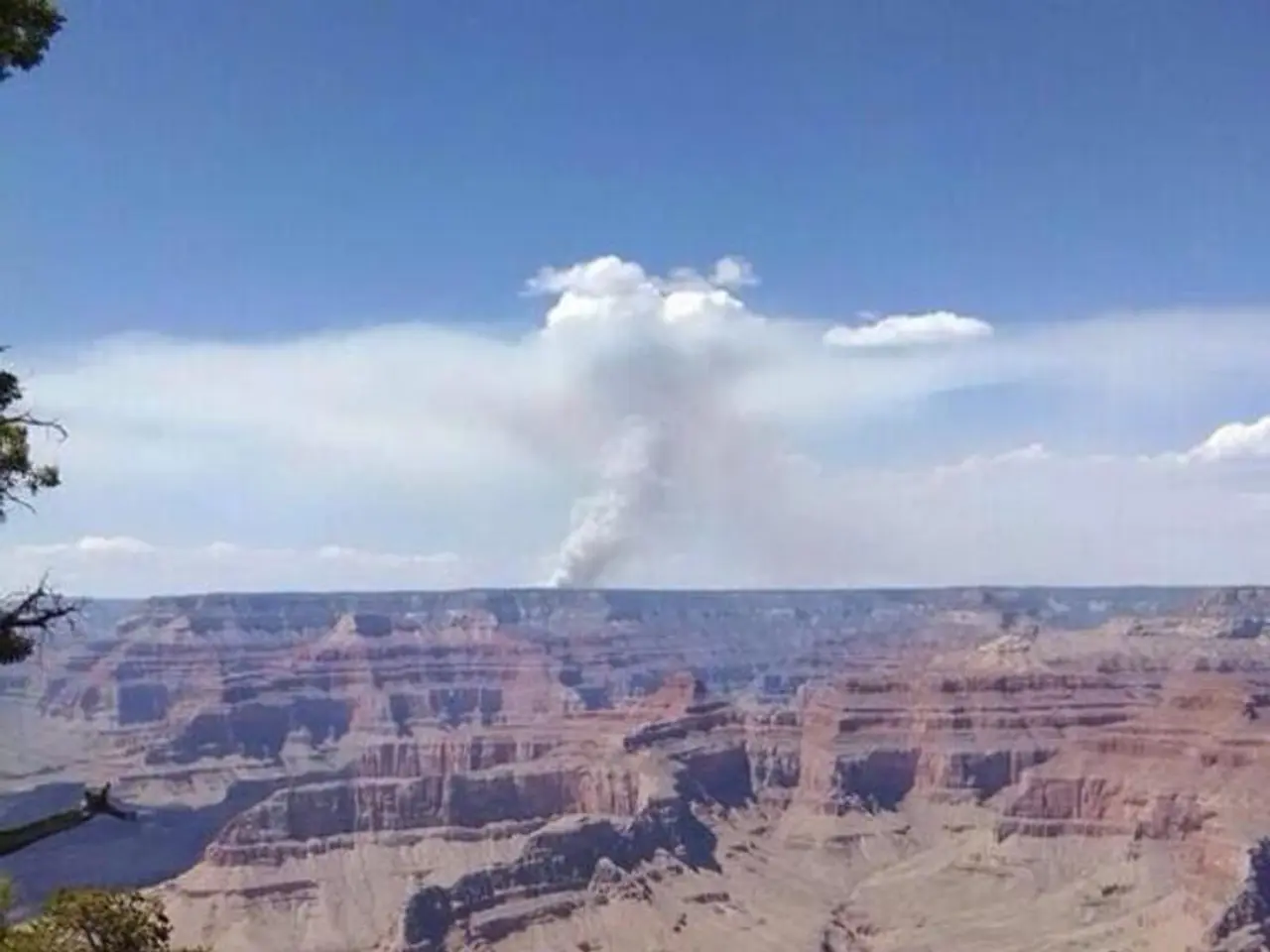
Awe-inspiring image of the Grand Canyon, viewed from afar, bears an uncanny resemblance to the Martian landscape.
NASA astronaut Don Pettit, who recently returned to Earth after a seven-month stay aboard the International Space Station (ISS), has been sharing awe-inspiring images he captured during his mission. Among these, a near-infrared image of the Grand Canyon, captured from 250 miles above, has caught the attention of many[1][2].
In an interview with SmugMug Films, Pettit discussed his passion for astronaut imagery of Earth and shared insights about the challenges and techniques involved in capturing images from space[3]. He described the Grand Canyon as an "orbital optical illusion," where the canyon appears as a "contorted bump" rather than a deep trench[1].
Pettit's earlier image of the Grand Canyon, also shared on social media platforms, exhibits a Mars-like quality[1]. This image, like the near-infrared one, wouldn't look out of place in an art gallery[4].
The astronaut emphasised the need to synchronise the camera's movement with the ISS's orbital motion to achieve the sharpest imagery, as the spacecraft travels at a speed of 8 kilometers per second[5]. He also highlighted the complexity of taking pictures in space, including the need to modify camera components for a vacuum environment and steadying the cameras to avoid motion blur[6].
Pettit, who has previously spent two long-duration stays aboard the ISS, one in 2002 and another in 2011, believes that astronaut imagery of Earth is a form of learning what to take pictures of and how to take them[7].
For those interested in viewing more of Pettit's work, a collection of some of the best images captured during his most recent ISS visit is available[4]. This includes another equally impressive image of the Grand Canyon, shared early on in his latest ISS mission[1].
In addition to the Grand Canyon images, Pettit has also shared a remarkable image of Comet C/2024 G3 Atlas, captured from about 235 million miles away[3]. However, specific details about other Grand Canyon images taken by Pettit from the ISS are not widely documented in the recent search results.
References: [1] https://www.space.com/grand-canyon-from-space-photos-from-nasa-astronaut-don-pettit.html [2] https://twitter.com/Astro_Pettit/status/1605956830336699392 [3] https://www.smugmug.com/gallery/n-Lz6Wc/i-rrDj3fX [4] https://www.space.com/grand-canyon-photos-from-space-by-nasa-astronaut-don-pettit.html [5] https://www.nasa.gov/mission_pages/station/main/index.html [6] https://www.nasa.gov/feature/nasa-astronaut-don-pettit-shares-images-from-space [7] https://www.nasa.gov/feature/nasa-astronaut-don-pettit-shares-images-from-space
Science, technology, and space-and-astronomy are integral elements in the captivating images captured by NASA astronaut Don Pettit during his mission aboard the International Space Station (ISS). In a discussion with SmugMug Films, Pettit detailed the challenges and techniques involved in capturing images of Earth from space, highlighting the need to synchronize the camera's movement with the ISS's orbital motion and modify camera components for a vacuum environment [3].




