
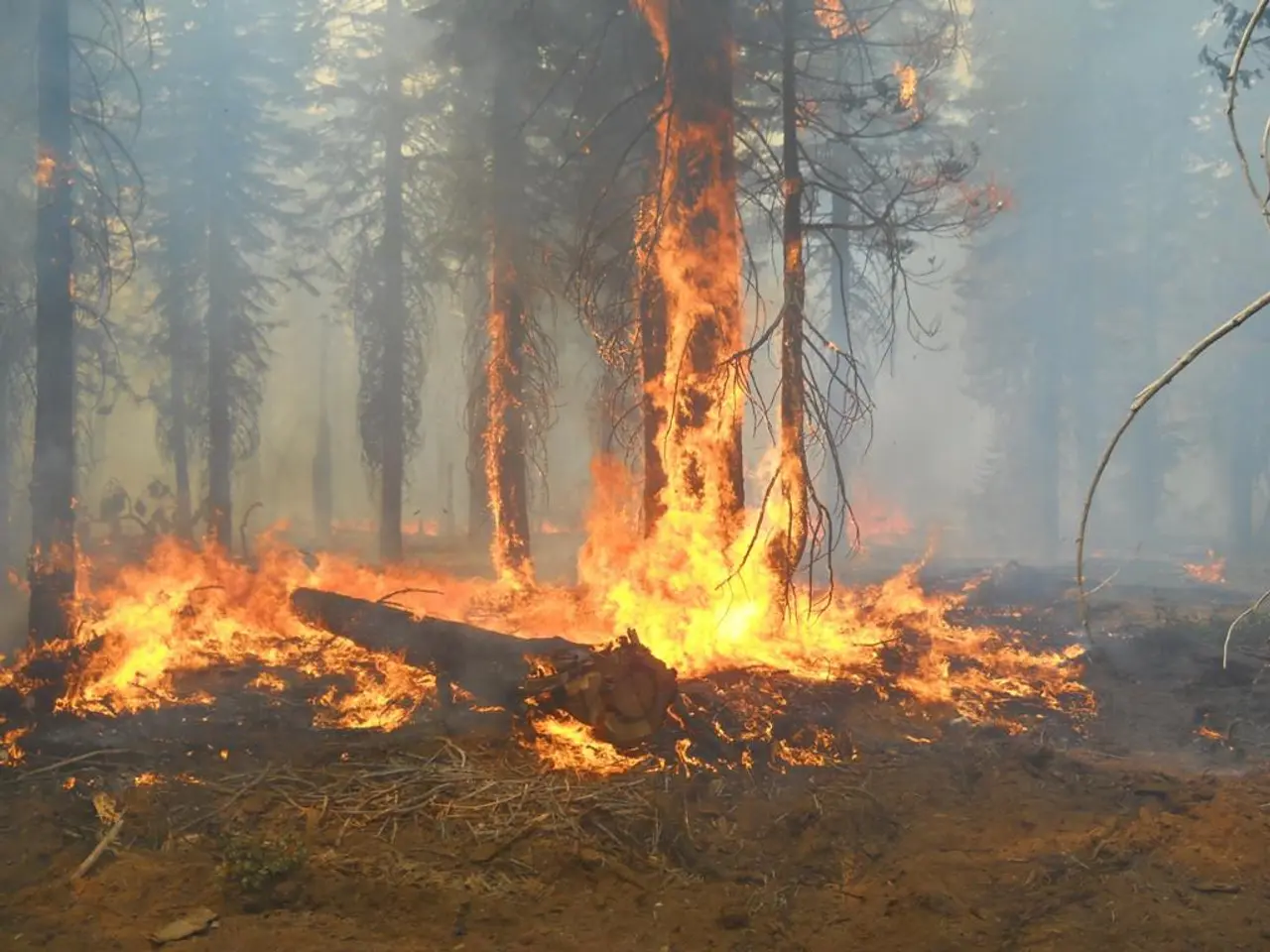
Forest Protection in a Warmer Climate Through Fireproofing Techniques
Artificial Intelligence Drone Technology Aids in the Fight Against Rising Forest Fires
The global threat of forest fires has been escalating, with wildfires wiping out 152 million hectares of trees between 2001 and 2024, accounting for a third of the total tree loss worldwide during the same period [1]. As fires become more frequent and intense due to rising global temperatures and climate change, faster action is crucial. One innovative solution to this growing problem is the adoption of AI-controlled drone technology for forest fire detection and extinguishing.
These autonomous drone systems, such as the AI-controlled "Silvaguard" drone developed by Dryad Networks, combine real-time autonomous wildfire detection, detailed aerial inspection, and targeted fire suppressant delivery [2]. Upon sensing smoke or heat anomalies with AI-powered sensors and cameras, drones launch automatically, navigate complex terrain, and conduct high-resolution optical and thermal imaging to verify and assess fire threats rapidly. Some drones carry payloads of fire retardants or water in limited volumes but operate as coordinated swarms to deliver multiple, precise treatment drops early in a fire's development, potentially suppressing fires before they spread extensively [1].
The integrated approach of these drone systems improves upon traditional methods by enhancing speed, precision, and safety, providing constant monitoring in high-risk areas day and night under varied environmental conditions. AI allows predictive risk modeling and strategic deployment by analysing weather, topography, and vegetation data, further increasing the effectiveness of firefighting teams and equipment allocation [5].
Commercial deployment plans for such AI-powered drone wildfire systems are underway in various regions. For instance, the Aspen Fire Protection District in Colorado, USA, is considering AI drone firefighting programs, and already uses AI camera systems for early smoke detection combined with drones for visual inspection and rapid fire response [3]. Additionally, forestry agencies and states in mountainous and forested regions like the Rocky Mountain range employ AI-driven prediction and monitoring systems, integrated with drone thermal mapping and fire detection, enabling operational advantages in wildfire response [5].
Moreover, companies like SmokeD offer commercial drone wildfire detection systems designed for environmental protection and outdoor infrastructure operators, positioning these technologies for broader commercial use in forest and wildfire management [1]. These deployments reflect a growing trend of adopting autonomous AI drone networks and advanced sensors to rapidly detect, assess, and respond to wildfires, particularly in forested mountainous regions prone to fire risk [1][2][3][5].
In Europe, the EU-partly funded "Dryad" drone system is set to be launched on the market in 2026, with an initial deployment outside Europe [4]. The "Dryad" drone is designed to analyse a fire situation, determine its size and location, and transmit this information to the fire department for quick response [4]. Furthermore, the "Dryad" makers hope that their drone will not only be able to detect fires but also extinguish them using sound cannons that emit low-frequency sound waves [4]. However, the regulatory framework for its commercial operation still needs to be established.
In the face of the growing threat of wildfires, it is clear that new measures are needed to prevent and fight forest fires. The adoption of AI-controlled drone technology offers a promising solution, providing rapid, precise, and safe responses to wildfire threats, and contributing to the protection of forests and the communities that depend on them.
References:
[1] SmokeD. (n.d.). About Us. Retrieved from https://smoked.ai/about
[2] Dryad Networks. (n.d.). Silvaguard. Retrieved from https://dryadnetworks.com/silvaguard
[3] Aspen Times. (2021, March 29). Aspen Fire Protection District considers AI drone firefighting programs. Retrieved from https://www.aspendailynews.com/news/local/aspen-fire-protection-district-considers-ai-drone-firefighting-programs/
[4] Dryad Networks. (n.d.). Dryad. Retrieved from https://dryadnetworks.com/dryad
[5] European Forest Institute. (2020). AI for Forest Management: An Overview. Retrieved from https://www.efi.int/knowledge/publications/ai-forest-management-overview
- The rise of global forest fires has alarmed the world, as over 152 million hectares of trees were lost between 2001 and 2024, accounting for a third of worldwide tree loss during that period [1].
- As global temperatures and climate change intensify, wildfires are becoming more frequent and intense, necessitating swift action [1].
- Innovative approaches to combating this growing concern include the use of AI-controlled drone technology for forest fire detection and suppression [2].
- AI-controlled drones, such as the Silvaguard drone by Dryad Networks, offer real-time wildfire detection, aerial inspection, and targeted fire suppressant delivery [2].
- Europe is set to commercially deploy the EU-partially funded "Dryad" drone system in 2026, which can not only detect but also extinguish fires using sound cannons [4].
- Companies like SmokeD develop commercial drone wildfire detection systems for environmental protection and outdoor infrastructure operators, positioning these technologies as potential solutions in forest and wildfire management [1].
- Adopting AI-controlled drone networks and advanced sensors is a growing trend in regions prone to fire risk, providing rapid, precise, and safe responses to wildfire threats [1][2][3][5].




