
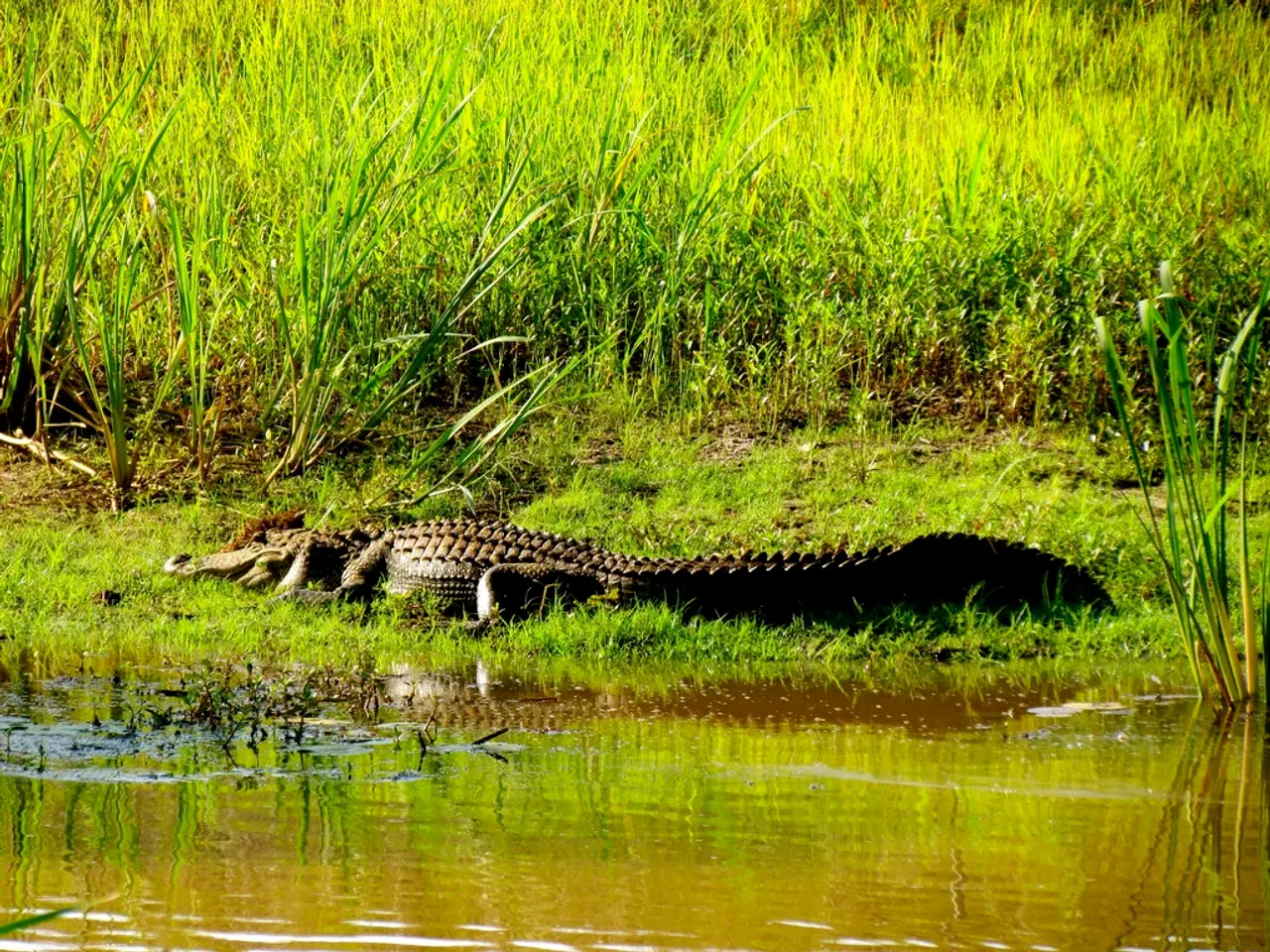
Giant crocodile outmatched many dinosaur species in size
In the lowland marshes and swamps of Cretaceous North America, a formidable predator ruled - the Deinosuchus, or "terrible crocodile." Around 75 million years ago, this colossal reptile, known for its size and crushing bite, was North America's largest predator [1].
The recent publication of a study in Communications Biology has shed new light on the success of this ancient crocodile species. Deinosuchus, it appears, combined enormous size, armored protection, and crushing bite power to become the dominant predator across diverse prey in the coastal wetlands of Cretaceous North America [2].
Reaching lengths of more than 35 feet (10 meters) and weighing over five tons, Deinosuchus boasted thick hemispherical osteoderms, providing it with robust, armor-like bony plates for protection against attacks [2]. Its powerful jaws and teeth were capable of crushing the bones of large prey, including sea turtles, fish, marine reptiles, and even dinosaurs [2][5].
The high-productivity wetlands were critical for the evolution of Deinosuchus. The nature of the aquatic ecosystems during the late Cretaceous allowed such giant reptiles to evolve, providing ample food and a suitable habitat for these apex predators [3].
Fossils of Deinosuchus have been found in various locations, including North Carolina, Mexico, Utah, Texas, Montana, South Carolina, New Jersey, and more [6]. However, the abundance of these fossils in coastal deposits may be a reflection of conditions for preservation rather than a preference for saltwater habitats [7].
The study argues that Deinosuchus' alligator-like appearance was likely a result of convergent evolution rather than a family resemblance [8]. It suggests that Deinosuchus belonged to an ancient lineage that split off before the last common ancestor of today's alligators and crocodiles [8].
Some researchers argue that Deinosuchus was more tolerant of salt water, but others question this assertion [9]. The new classification suggests that Deinosuchus was more like a saltwater crocodile than an American alligator, allowing the ancient croc to be associated with saltier habitats like estuaries and ocean coasts [10].
New York Institute of Technology paleontologist Adam Cossette questions some of the methodologies used in the new study but notes that the new placement makes sense [4]. The study's claim that Deinosuchus had a bite force greater than that of T. rex adds to its awe-inspiring reputation [7]. Bite marks on bones suggest that Deinosuchus caught and ate dinosaurs, further cementing its status as a top predator [7].
In essence, the study provides valuable insights into the adaptations that enabled Deinosuchus to thrive in its environment and become the dominant predator in the coastal wetlands of Cretaceous North America. The findings not only enrich our understanding of this ancient species but also offer valuable insights into the evolution of predators in various ecosystems.
- The study published in Communications Biology reveals that the Deinosuchus, a Crocodile-like species from the Cretaceous period, thrived due to its combination of immense size, armored protection, and crushing bite power.
- The maturing wetlands during the late Cretaceous played a crucial role in the evolution of the Deinosuchus, providing ample food and suitable habitats for these apex predators.
- Deinosuchus, with lengths exceeding 35 feet and weights over five tons, possessed thick armor-like bony plates and powerful jaws capable of crushing the bones of various species such as sea turtles, fish, marine reptiles, and even dinosaurs.
- Fossils of Deinosuchus have been discovered in numerous locations across North America, suggesting a wide range of its habitats including freshwater and potentially saltwater environments.
- The new study suggests that Deinosuchus was more closely related to saltwater crocodiles, implying a preference for saltier habitats like estuaries and ocean coasts, a claim that some researchers question.
- The study also contends that Deinosuchus had a bite force greater than that of T. rex, adding to its fearsome reputation as a top predator.
- The adaptations of the Deinosuchus, as revealed by the study, offer valuable insights into the evolution of predators in various ecosystems, expanding our knowledge not only of this ancient species but also of the broader history of life on Earth.




