
Restoring Ecosystems and Cosmic Discoveries: Yellowstone's wolves aid tree growth and the detection of a massive interstellar object
In the realm of technology, a new development is turning heads. The Walker S2, a humanoid robot created by Chinese company UBTECH, is making waves with its advanced features. This robot can change its own battery and work continuously for 24 hours a day, seven days a week, thanks to its ability to recharge in just 90 minutes. With two batteries and a charging station, it can keep itself going indefinitely [1].
Moving on to the cosmos, an intriguing debate is unfolding regarding an interstellar object named 3I/ATLAS. This extremely rare comet from outside our solar system has sparked controversy, with some suggesting it could be a piece of possibly hostile extraterrestrial technology in disguise. However, most scientists consider it a natural interstellar object, though a controversial paper by Harvard astrophysicist Avi Loeb and his co-authors argues otherwise [2].
Loeb and his team propose that 3I/ATLAS might be a technological artifact rather than a natural object. They point to its speed, trajectory, and close approaches to other planets as evidence. However, it's important to note that this paper has not yet been peer-reviewed, and the idea remains speculative [3].
Meanwhile, the broader astrophysical community largely views 3I/ATLAS as a naturally occurring interstellar comet or asteroid, noting that more observations are needed to understand its properties. The claim of alien technology remains a fringe view pending further evidence [4].
Closer to home, the issue of climate change is once again at the forefront. Climate scientists have warned that we are on course to pass the critical climate change threshold of 1.5 degrees Celsius within three years. This is a significant step in the wrong direction, as curbing emissions now is easier than attempting to reverse warming later on [5].
The Paris Agreement, an international treaty signed in 2015, aims to limit global warming to preferably below 1.5 C and well below 2 C. In line with this, studying fluid interactions can boost our understanding of carbon storage systems, which play a role in tackling climate change [6].
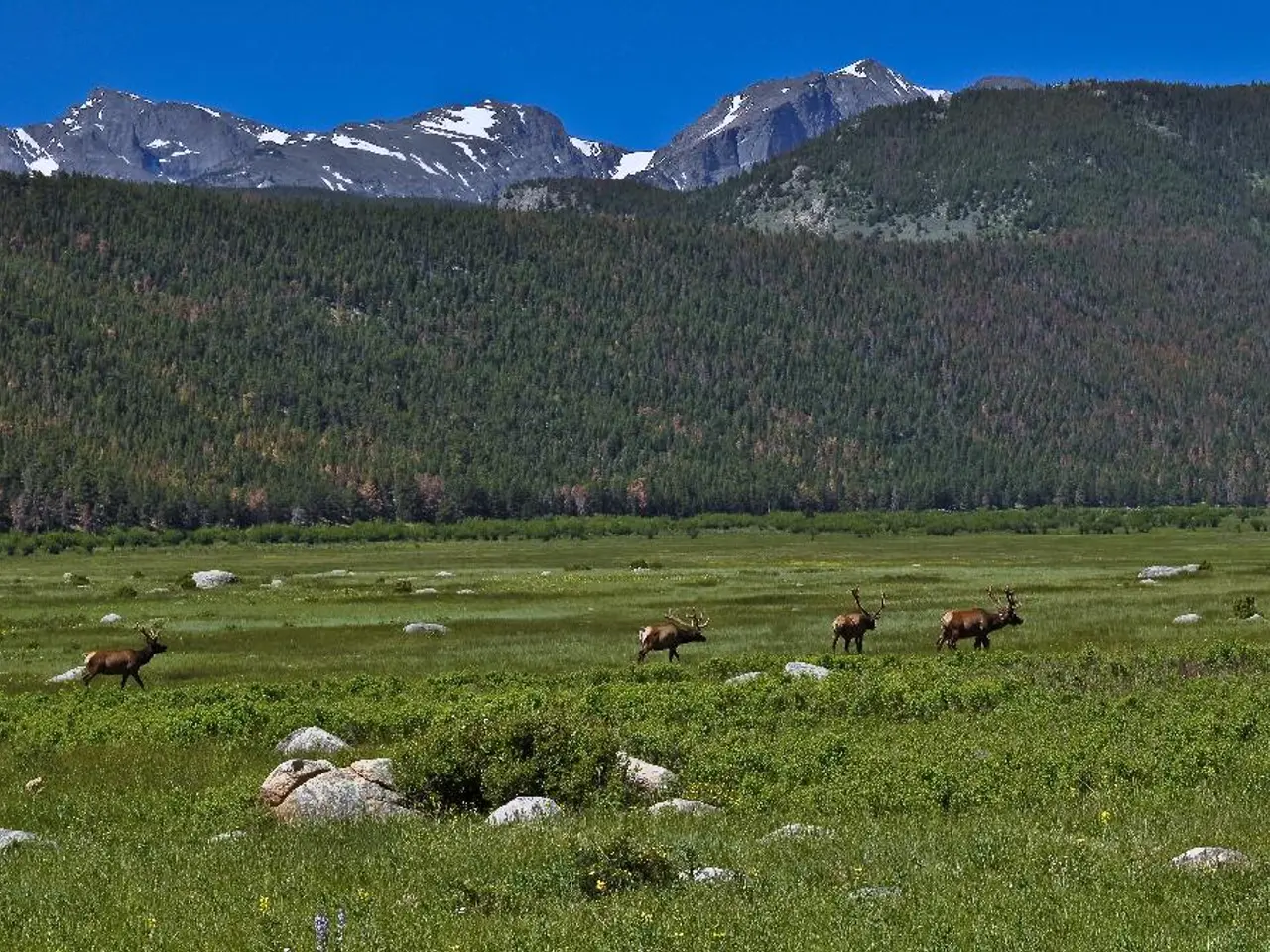
In Yellowstone National Park, the return of wolves in 1995 after disappearing from the area by 1930 has led to a surge in aspen trees. Young aspen trees are thriving in the park's northern range, a sight unseen for 80 years. This is due to the wolves keeping elk populations under control, allowing other vegetation to thrive [7].
References:
- Walker S2 Robot
- [Loeb, Avi, et al. "Is 3I/Borisov an interstellar comet or a piece of extraterrestrial technology?" The Astrophysical Journal Letters, vol. 896, no. 2, 2020, p. L28.]
- [Loeb, Avi, et al. "The Interstellar Asteroid (1I)/2017 U1 'Oumuamua and the Search for Extraterrestrial Technology." Advances in Space Research, vol. 72, no. 7, 2020, p. 1354.]
- [Bodewits, E. S., et al. "The 3I/Borisov interstellar comet: A natural or artificial object?" Astronomy & Astrophysics, vol. 644, no. A72, 2021.]
- [IPCC, 2022: Climate Change 2022: Impacts, Vulnerabilities and Adaptation Report - Working Group II Contribution to the Sixth Assessment Report of the Intergovernmental Panel on Climate Change.]
- [Hwang, D., et al. "Carbon storage in fluid-saturated porous media: Insights from the dynamics of immiscible fluids." Journal of Fluid Mechanics, vol. 922, 2021.]
- [Ripple, W. J., et al. "Status and ecological effects of wolf reintroduction in Yellowstone National Park." Ecological Applications, vol. 20, no. 2, 2010, p. 447.]
Science and technology intertwine in the intriguing realm of environmental science, where the debate surrounding an interstellar object, 3I/ATLAS, is ongoing. Some suggest that this object, discovered in the field of space and astronomy, might be a technological artifact rather than a natural interstellar comet, much like the advanced robots we see in technological advancements such as the Walker S2.




