
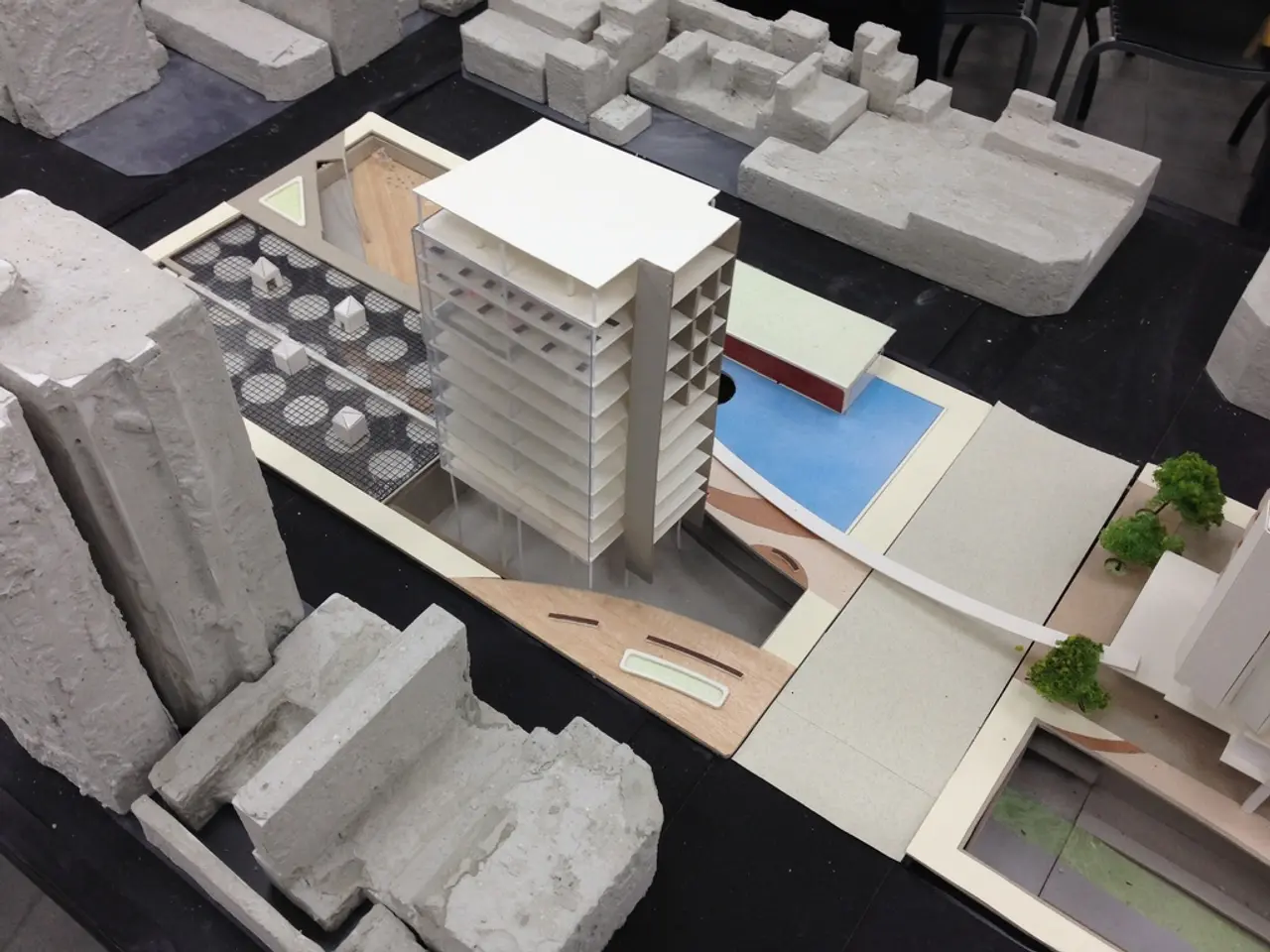
Specialization Institute: Focus on Stone and Composite Materials
In the realm of modern construction, hybrid systems are making a significant impact, and none more so than hybrid stone construction. This innovative method, which combines the timeless appeal of stone with the efficiency of contemporary materials, offers numerous advantages for both clients and the environment.
One of the key benefits of hybrid stone construction is its efficiency. With proper planning, these systems allow for efficient scheduling, fewer on-site labour requirements, and reduced manual handling, as most components are now installed with cranes. This streamlined approach leads to lighter, more resource-efficient structures, thanks to engineering constraints that favour sustainability.
Contemporary hybrid stone construction typically includes vertical compressive elements, like stone used in columns and shear walls, steel and concrete systems, and augmented stone floor slabs. These reinforced stone slabs, paired with concrete columns and cross-laminated timber (CLT) shear walls, provide a perfect blend of durability and lightness.
The processing and installation of stone require very little water, making it a highly sustainable choice. Moreover, hybrid stone buildings can be disassembled for reuse, promoting sustainability in the long term.
However, it's important to note that the design process for hybrid stone buildings is slower and more iterative. Clients need to understand this, as well as the fact that not all engineers or quantity surveyors are familiar with hybrid systems, which may complicate cost management and risk evaluation. Construction teams must be trained in working with a diverse range of materials.
Prefabrication-friendly is another advantage of hybrid stone construction, as stone, like steel and timber components, can be prefabricated off-site. This allows for better planning, coordination, and quality control. Design optimisation is possible with prefabrication, as it requires careful design of interfaces early on, helping to anticipate and resolve construction issues before they arise.
Hybridisation in construction goes beyond mixing materials; it involves organising materials hierarchically for maximum performance, with different materials used for different parts of the building based on their strengths and costs.
Applications of these hybrid stone constructions cover structural elements in commercial and residential buildings, large-scale infrastructure projects for slope stabilisation, retaining walls, and flood control, and urban and landscaping design for noise attenuation, visual screening, and aesthetic enhancement.
Gabion walls, wire mesh cages filled with stone, are another hybrid typology used for soil stabilisation, erosion control, retaining walls, noise barriers, and aesthetic landscaping applications. They combine the natural appearance and mass of stone with the flexibility and permeability of metal mesh, making them suitable for both functional infrastructure and urban design.
Hybrid retaining walls may also combine features from different designs, for example, mechanically stabilised earth (MSE) walls using reinforced soil layers with concrete panel facings, sometimes integrating stone gabion facings for improved drainage and aesthetics.
In conclusion, hybrid stone construction offers a sustainable and efficient approach to modern construction. By using stone selectively in high-stress areas, prefabrication potential for quality control, and efficient on-site assembly aided by cranes and precise interface design, these hybrid approaches provide improved material efficiency, logistics, and adaptability over time. Thus, common hybrid stone typologies are primarily combinations of stone vertical load-bearing components with steel, concrete, or timber horizontals, along with stone-filled gabions for earth retention and landscaping, applied across structural, civil infrastructure, and design domains.
[1] Hybrid Stone Construction: An Overview (2021). Retrieved from [https://www.researchgate.net/publication/351339486_Hybrid_Stone_Construction_An_Overview] [2] Gabion Walls: Applications and Design (2018). Retrieved from [https://www.researchgate.net/publication/326710166_Gabion_Walls_Applications_and_Design] [3] Hybrid Retaining Walls: Design and Performance (2019). Retrieved from [https://www.researchgate.net/publication/331222131_Hybrid_Retaining_Walls_Design_and_Performance] [4] Hybrid Stone Construction: A Sustainable Approach for Mid-Rise Buildings (2020). Retrieved from [https://www.researchgate.net/publication/343110686_Hybrid_Stone_Construction_A_Sustainable_Approach_for_Mid-Rise_Buildings] [5] Urban Design with Gabion Walls: A Case Study in Sustainable City Planning (2021). Retrieved from [https://www.researchgate.net/publication/352943639_Urban_Design_with_Gabion_Walls_A_Case_Study_in_Sustainable_City_Planning]
- The efficiency of hybrid stone construction, as seen in its integration with contemporary materials like steel and concrete, leads to lighter, resource-efficient structures, leveraging technology to foster sustainability.
- The processing and installation of stone in hybrid stone construction, which requires very little water, makes it a highly sustainable choice, demonstrating the potential of technology to minimize environmental impact.