
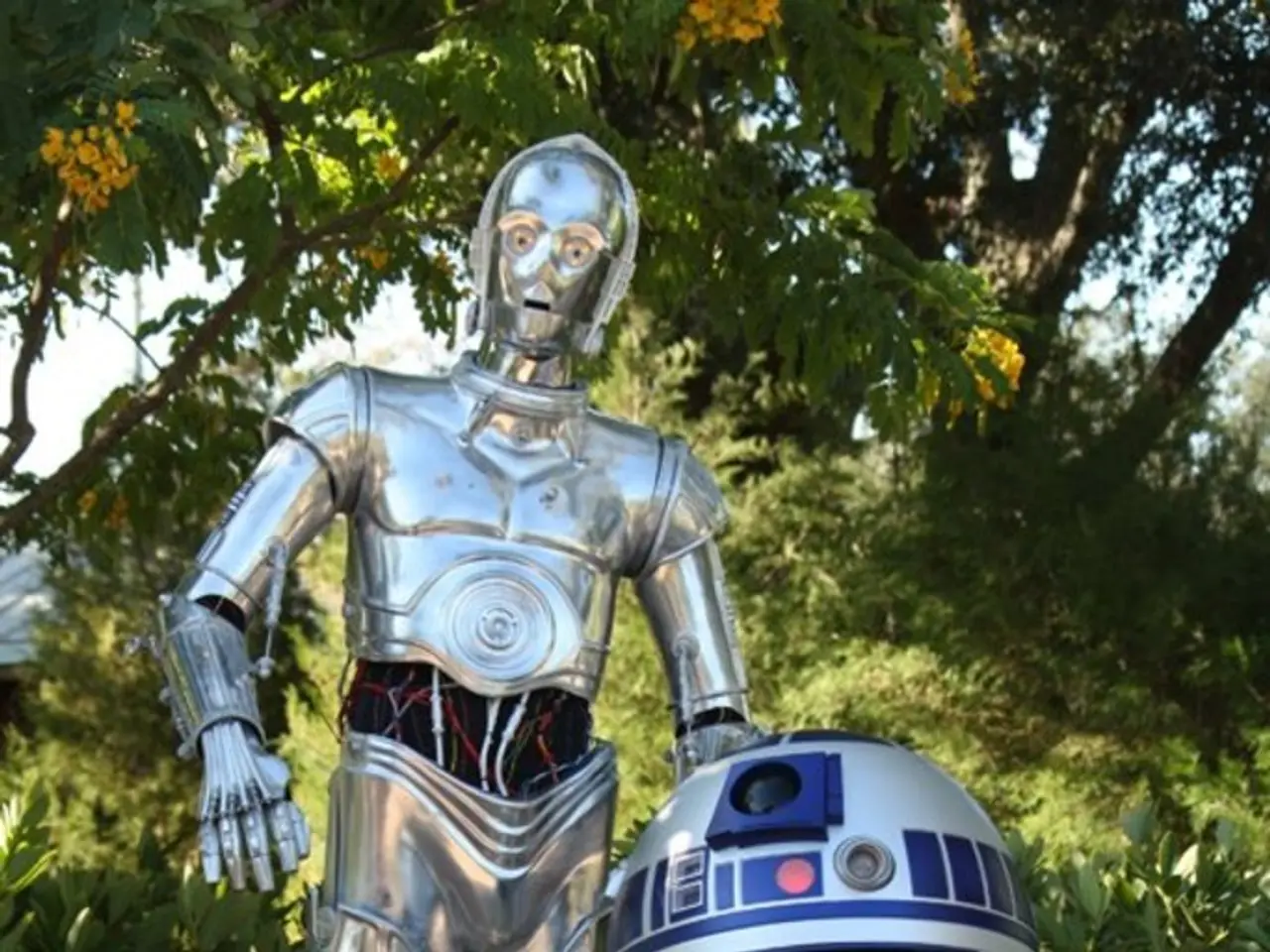
The distinctions between robotics and the Internet of Things (IoT)
In a world where technology is rapidly advancing, the integration of Internet of Things (IoT) and robotics is transforming various sectors, making operations more efficient and streamlined. This article explores the integration of IoT-enabled robots and Robotics-as-a-Service (RaaS) across industries such as manufacturing, logistics, healthcare, security, and agriculture.
Manufacturing and Industrial Sector
Leading companies like ABB, Fanuc, Airbus, and Magna Steyr are employing IoT-connected robots for predictive maintenance, real-time condition monitoring, and autonomous decision-making. By using sensors and cloud analytics, these robots can predict component failures and enable scheduled repairs, reducing costs and downtime.
Logistics and Warehousing
Providers like Locus Robotics and inVia Robotics offer IoT-connected robots as a service for tasks such as picking, sorting, and material transport in warehouses. These robots use sensors and cloud connectivity for real-time data exchange, enabling flexible scaling of automation without significant capital expenditures.
Healthcare
Robots with IoT capabilities are being used in hospitals for tasks like autonomous medicine and supply delivery. IoT integration improves robots' adaptability and monitoring, while RaaS models make advanced robot services more accessible to healthcare providers.
Security
Autonomous security robots, such as those from Knightscope, use IoT sensors (cameras, microphones, thermal sensors) to patrol and detect anomalies in real time, reporting data to centralized systems for analysis. RaaS platforms allow clients to deploy security robots flexibly on-demand.
Agriculture
Smart agricultural robots utilize IoT sensors to monitor environmental conditions and crop health, enabling precise interventions and autonomous operations. These robots are increasingly offered via RaaS models to farms aiming to optimize yields without heavy upfront investments.
Common features across these examples include multi-sensor IoT integration, cloud connectivity and data analytics, AI and machine learning, and RaaS business models. These developments are accelerated by emerging technologies like 5G, which allows low-latency, high-throughput communication for real-time coordination of robots and IoT devices on large scales.
While robotics and IoT are distinct fields, their integration is leading to even smarter and more autonomous systems, driving the future of automation and connectivity. IoT devices primarily collect and share data for automation and insights, unlike robots that perform specific tasks. IoT plays a crucial role in smart homes, healthcare, smart cities, and Industrial IoT (IIoT) applications, while robotics is revolutionizing industries by automating tasks and improving efficiency.
In conclusion, the integration of IoT and robotics is reshaping industries, making operations more efficient, and paving the way for a future where smart, autonomous systems are the norm. With RaaS models, advanced robot services are increasingly accessible, lowering financial barriers and supporting scalability. The future of automation and connectivity is here, and it's only getting smarter.
[1]: Reference for Manufacturing examples [2]: Reference for Logistics, Healthcare, Security, and Agriculture examples [3]: Reference for Manufacturing and 5G [4]: Reference for Logistics and 5G [5]: Reference for Manufacturing and RaaS models
- The integration of IoT and robotics is not limited to the manufacturing sector, as it is also being used in logistics, healthcare, security, and agriculture.
- Artificial Intelligence and Machine Learning are key technologies being employed in these IoT-connected robots, enabling them to predict component failures, detect anomalies in real time, and optimize crop health.
- Cloud Computing plays a significant role in these advanced systems, as it enables real-time data exchange, predictive maintenance, and flexible scaling of automation without significant capital expenditures.




)