
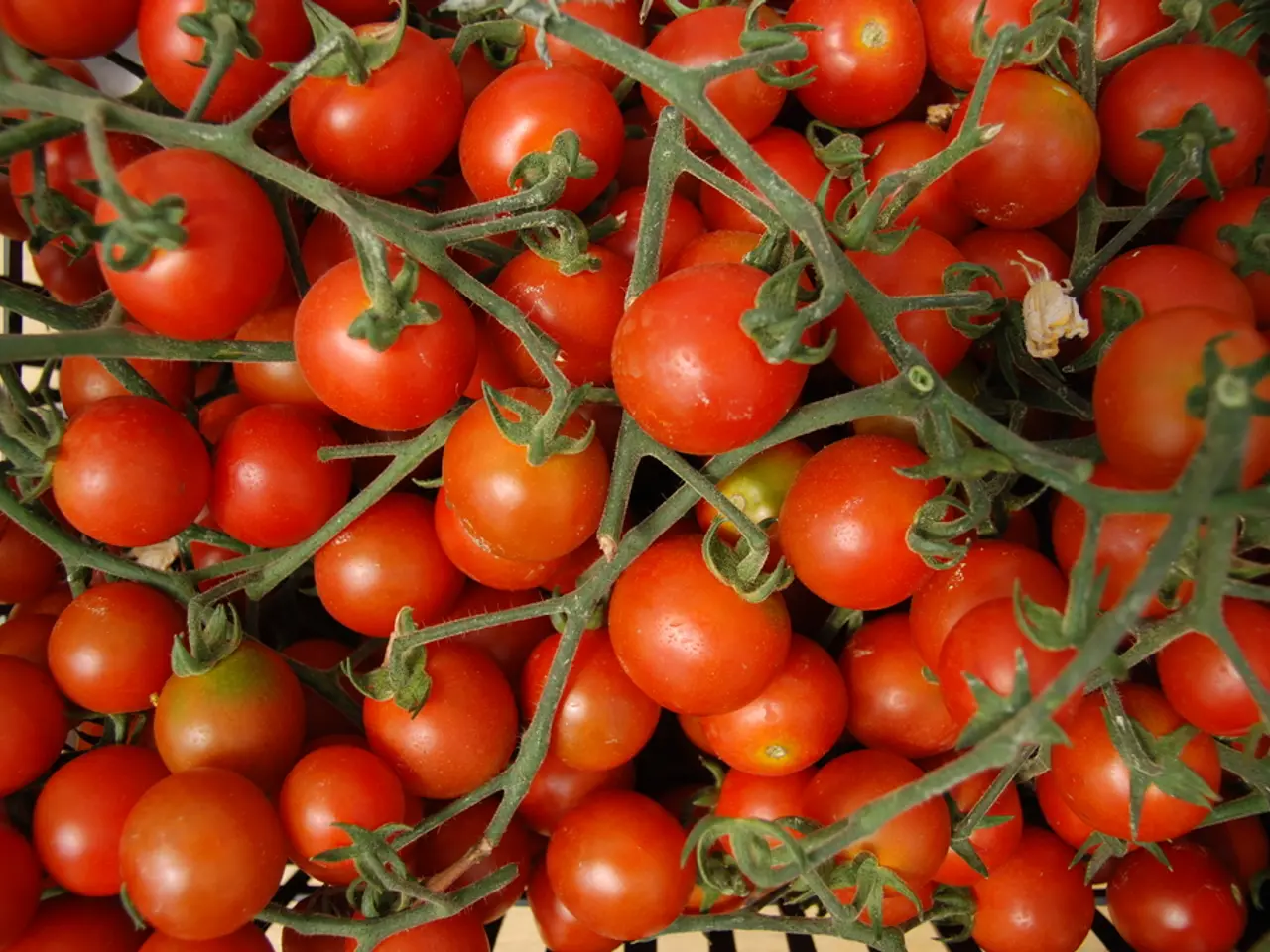
Tomatoes and a wild potato relative entwined to give birth to the humble potato
In a groundbreaking study published in the prestigious Cell journal, researchers have shed new light on the ancient origins of the humble potato [1][2][3]. The study, titled "Ancient hybridization underlies tuberization and radiation of the potato lineage," offers fascinating insights into the potato's evolutionary history.
Approximately 8-9 million years ago, the potato came into existence as a result of an accidental hybridization between an ancestor of the modern tomato and a now-extinct member of the wildflower group Etuberosum. This hybridization occurred around the same time as the uplift of the Andes mountains, creating challenging environments for the new hybrid lineage to colonize [1][2].
Interestingly, the potato is not alone in its tuber-bearing relatives. It shares this trait with 107 others, all of which are part of the same evolutionary family tree known to botanists as Petota. The potato lineage had two very close relatives: the Tomato lineage and the Etuberosum lineage [1].
The tuber acted as a survival pack for the early hybrid potatoes, providing energy and water for cold winters and dry seasons, and offering a reliable method of asexual reproduction. Crucially, a gene from the tomato ancestor enabled the development of large, swollen underground tubers in the new lineage, leading to efficient asexual reproduction and adaptation to harsh mountainous environments like the Andes. This evolutionary innovation allowed potatoes to diversify extensively and become a major food crop [1][2].
To further understand the potato's unique genetics, a team of researchers led by scientist Sanwen Huang used cutting-edge technology, including CRISPR, to analyze the genomes of 101 wild potato species for the first time [1]. Their findings confirm that the potato's genome has parts similar to both the tomato and Etuberosum genomes, indicating a single, ancient hybridization event.
The tuber, a distinctive organ of potatoes, was not present in either the tomato or Etuberosum ancestor species. Researchers found that the genetic pathways controlling tuber formation in potatoes are a patchwork of genes inherited from both the tomato and Etuberosum ancestors.
This new understanding of the potato's hybrid origins could help researchers hybridize new, more resilient or nutritious variants of potatoes. However, the world's current potato production of approximately 375 million tonnes is vulnerable to various pests, diseases, and environmental stresses.
The study provides an unprecedented, high-definition view into the potato's deep genetic past, offering insights into the evolution of the potato and the role of hybridization in the evolution of other species as well. The dataset represents the most comprehensive collection of wild potato genomic data ever analyzed [1].
In summary, the potato's tuber represents a novel trait arising from the combination of separate evolutionary lineages, illustrating how hybridization can create new forms and functions in plants. Hybridization can be a powerful and creative force, acting as an "evolutionary catalyst" that merges ancient genetic lineages to produce novel traits and jump-start the colonization of new worlds.
[1] Huang, S., et al. (2022). Ancient hybridization underlies tuberization and radiation of the potato lineage. Cell, 181(6), 1498-1511.e16. [2] https://www.cell.com/cell/fulltext/S0092-8674(25)00736-6 [3] https://www.cell.com/trends/genetics/fulltext/S0168-9525(22)00134-3
This article is not sponsored or endorsed by Cell or its publishers. The provided links are for informational purposes only.
- The study in Cell journal reveals that 8-9 million years ago, the potato's evolution began through an accidental hybridization between a tomato ancestor and a now-extinct wildflower, around the same time as the Andes mountains uplift.
- This hybridization also contributed to the existence of 107 other tuber-bearing plants, all part of the same family tree called Petota.
- Genetic analysis of 101 wild potato species, led by scientist Sanwen Huang and using cutting-edge technology like CRISPR, confirmed the potato's genome carries DNA from both its tomato and Etuberosum ancestor species.
- The potato's unique tuber trait, absent in either of its ancestor species, was found to be a combination of genes from both lineages controlling tuber formation.
- A gene from the tomato ancestor allowed potatoes to develop large, swollen underground tubers, aiding adaptation to harsh mountainous environments like the Andes and contributing to their extensive diversification and widespread use as a food crop.
- The study highlights the creative potential of hybridization, demonstrating how blending evolutionary lineages can produce novel traits and enable species to colonize new worlds.
- Despite the findings, the world's current potato production is susceptible to various pests, diseases, and environmental stresses, necessitating research into hybridizing new, more resilient or nutritious variants.




